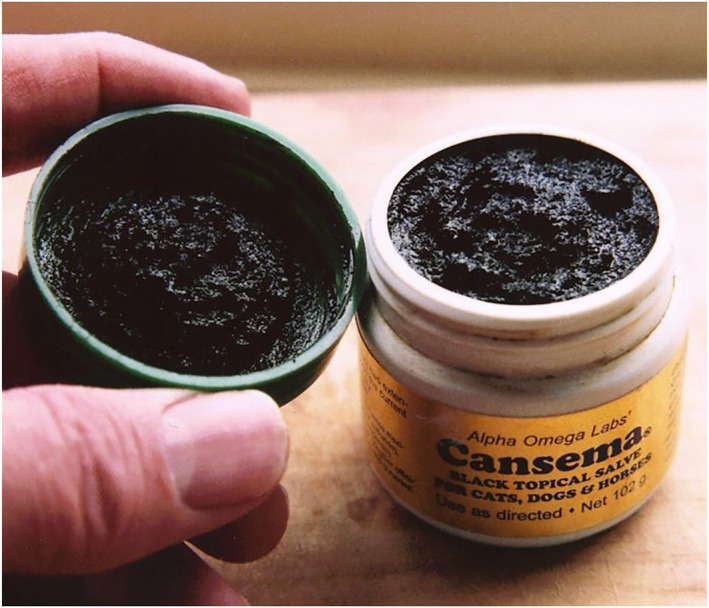
Every so often a patient will pull a small jar out of their pocket in the exam room and show me a black, tarry paste. Sometimes it arrived by mail from a website. Sometimes a friend or family member gave them a jar. The label may say Black Salve, Cansema, or Compound X. The pitch is always similar: apply this to a growth, wait a few days, and the growth will "fall off." No surgery, no scalpel, no dermatologist required.
I understand the appeal. However, the downsides are real, and I strongly recommend against using it.
Black Salve
Most black salves contain two active ingredients: bloodroot (Sanguinaria canadensis) and zinc chloride. Together they form what is called an escharotic — a corrosive paste that kills whatever tissue it sits on, healthy or diseased. The name comes from the eschar, or thick dark scab, that forms after the tissue dies. When the scab eventually sloughs off, it takes a chunk of skin with it.
That is the entire mechanism. Black salve does not recognize a tumor. It does not distinguish a mole from a melanoma, or a seborrheic keratosis from a basal cell carcinoma. It simply burns whatever it is applied to: healthy or diseased. Manufacturers rarely publish concentrations, so identical-looking jars can vary widely in strength.
The Patient Perspective
A survey of black salve users published in JAAD in 2016 found that most users had not spoken to a physician before applying it. Users trended more rural and lower-income, and the strongest predictor of a positive experience was the perception that the growth had been "removed" — not whether the treatment was painful or left a scar. Marketing plays up the words "natural," "traditional," and "cheap," and downplays the fact that the FDA lists these preparations on its published list of fake cancer cures.
Patients also arrive with an entirely reasonable frustration: dermatology is not always easy to access, biopsies can feel invasive, and Mohs surgery on the face sounds intimidating. If someone tells you a jar of paste can dissolve a skin cancer for a few dollars, you may be inclined to believe it.
Skin Effects
The dermatology literature on black salve is not subtle. A 2011 JAAD review titled Buyer beware: a black salve caution catalogued cases of severe, permanent cosmetic disfigurement in patients who used these products on the face — sunken craters, retracted eyelids, missing nasal cartilage, deforming scars. A 2025 JAAD Case Reports paper documented a patient who tried to self-treat a melanoma in situ with black salve, developed such extensive tissue destruction that she required hospitalization, and still needed conventional surgical management of the underlying cancer.
The recurring theme in these cases is not that black salve failed to burn tissue. It burned exactly as advertised. The problem is that the burn does not correlate with the tumor. Superficial skin cancers often extend down into the deeper dermis or subcutaneous fat, and no topical paste is going to reach those cells. What frequently happens is that the visible portion of the growth is destroyed, the wound heals over, and the deep component keeps growing under the scar — hidden, harder to identify on re-examination, and sometimes much larger by the time it is finally biopsied.
The Inconsistency Problem
The other issue is that patients rarely know what they are treating in the first place. I have seen black salve applied to benign moles, to seborrheic keratoses, to angiomas — none of which needed aggressive treatment. When applied to melanomas, it can destroy the surface of the skin making staging dubious and may compromise sentinel lymph node evaluation later.
FDA-Approved Alternatives
For patients who genuinely want to avoid the operating room, there are FDA-approved topical options with real clinical trial data behind them for treating selected, low-risk skin cancers:
- 5-fluorouracil (Efudex) 5% cream — used for actinic keratoses and superficial basal cell carcinomas. Applied at home over 3–6 weeks; the treated skin gets red and irritated, then heals.
- Imiquimod (Aldara, Zyclara) — an immune modulator that recruits your own immune system to attack abnormal cells. Also used for actinic keratoses and superficial BCCs.
- Tirbanibulin (Klisyri) — a newer FDA-approved topical for actinic keratoses. Applied once daily for five days, with less prolonged irritation than 5-FU.
None of these are magic, and each has its own side-effect profile. But they have been studied, they have known concentrations, and they are used under the guidance of a physician who can tell you what you are actually treating and what to expect.
Affordability Is Not the Barrier It Used to Be
A common concern is cost. Brand-name topical prescriptions have historically been expensive, but that has changed. Generic fluorouracil 5% cream is available through Mark Cuban's Cost Plus Drugs and similar transparent-pricing programs for around $20–30 a tube. Dermatologists often send prescriptions through compounding companies like SkinMedicinals or Simple RX Pharmacy (they offer combination topicals at fixed cash prices without insurance games). A course of legitimate, FDA-recognized therapy often costs less than a jar of black salve from a boutique website.
Buyer Beware
If you are considering black salve for anything that might be skin cancer, please stop and get evaluated by a dermatologist. Even for something you think is benign, the exuberant ulceration and tissue destruction these preparations produce is not selective, is not measurable, and is not reversible. Many patients wished they had walked into a dermatology office first.
Disclaimer: This article is general educational content, not medical advice. If you have a skin lesion you are concerned about, see a board-certified dermatologist for evaluation before starting any treatment.
References
Sivyer GW, Rosendahl C. Community perceptions about the use of black salve. J Am Acad Dermatol. 2016.
Osswald SS, Elston DM, Farley MF, et al. Buyer beware: a black salve caution. J Am Acad Dermatol. 2011;65(5):e154–e155.
A case of compound X (black salve) self-treated melanoma in situ leading to hospitalization and extensive tissue damage. JAAD Case Reports. 2025.
Almirall. FDA approval of Klisyri® (tirbanibulin), December 14, 2020.
Cost Plus Drugs. Fluorouracil 5% cream (generic Efudex).