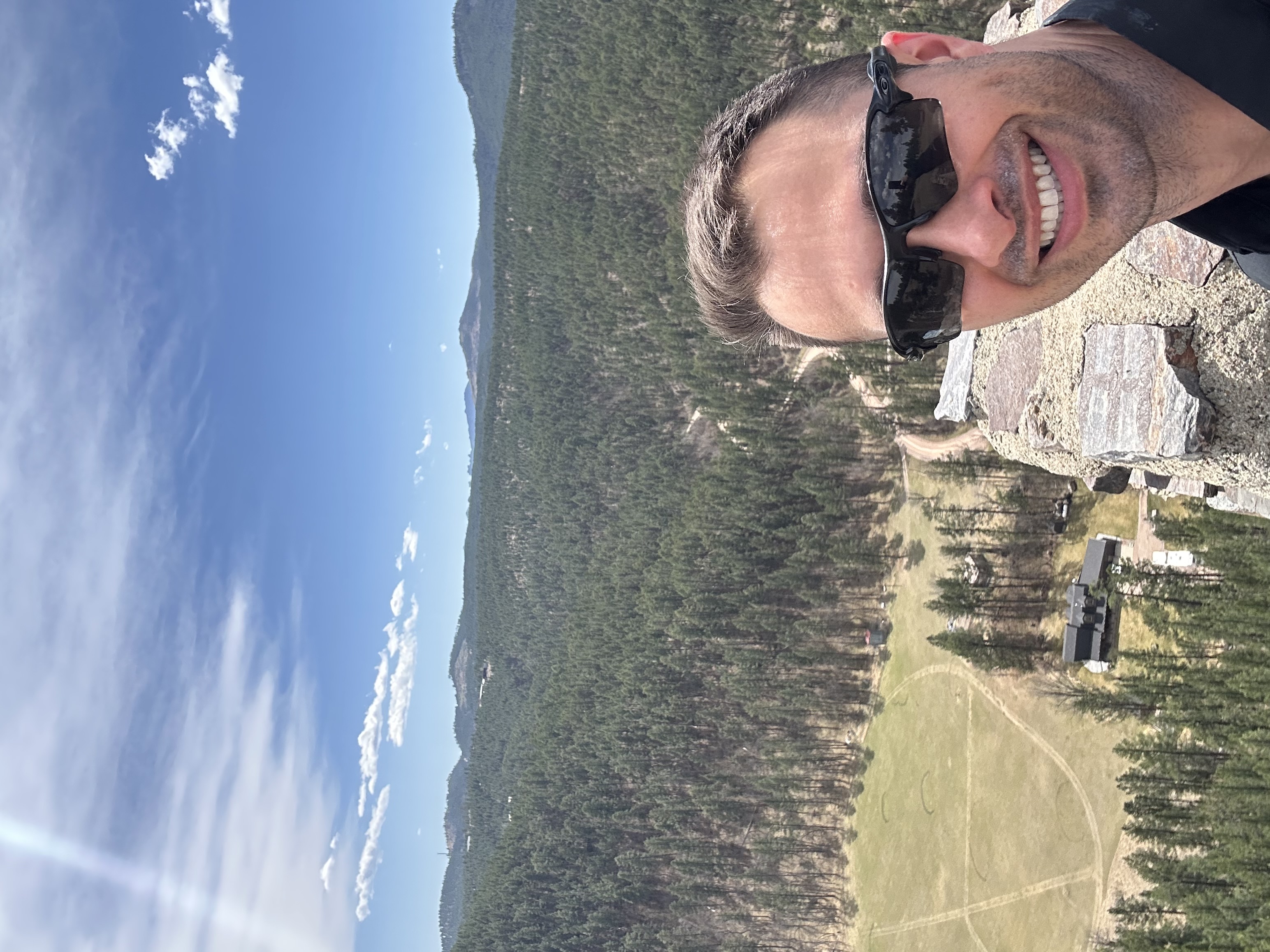
About a month ago I hiked the Stratobowl Rim trail in the Black Hills of South Dakota. It is a short, rewarding hike — a couple of miles out and back — that ends at a granite outcrop perched over a sweeping, protected basin. From the rim you look down into a natural bowl ringed by pine trees, and it is easy to see why this place once mattered to the early aviators who launched from the floor below.
A Piece of Aviation History
On November 11, 1935, the Stratobowl was the launch site of Explorer II — a hydrogen-replaced-with-helium balloon roughly 300 feet tall, sponsored by the National Geographic Society and the U.S. Army Air Corps. Captains Albert W. Stevens and Orvil A. Anderson rode up inside a sealed, spherical gondola and climbed to 72,395 feet, just shy of 14 miles above the earth. It was a world altitude record, and it stood for the next two decades.
The Stratobowl was chosen for a simple, practical reason: the surrounding rim acts as a windbreak, allowing a balloon of that size to be inflated on the ground without being damaged before it ever left. Standing on the rim today, you can still see why it worked. The bowl is quiet, sheltered, and almost startlingly geometric — a piece of landscape that happened to be perfectly shaped for a single moment in the history of flight.
Ninety Years On
What struck me, sitting on the rim, was how quickly the frontier moves. In 1935, two men in wool flight suits inside a metal sphere were the cutting edge of how high a human being could go. The photographs they brought back of the curvature of the earth were among the first the public had ever seen. It was, at the time, genuinely radical work.
Ninety years later, the conversation is no longer about whether people can reach the stratosphere. It is about whether we should be putting AI data centers in orbit — moving the compute itself off the planet so that the heat, the power, and eventually the silicon live in space rather than on the ground. The leap from a manned balloon to an orbital server farm in a single human lifespan may even surprise a science fiction novelist like Isaac Asimov.
And yet from where we stand now, Explorer II looks almost quaint. A balloon. A spherical aluminum cabin. A wool suit. Two men with a camera.
What Will Seem Quaint?
That is the part that has stayed with me. If a balloon at 72,000 feet — the absolute frontier of human achievement in 1935 — now reads as a charming relic, what are we doing right now that will read the same way to our grandchildren? The smartphone we cannot put down? The car with a person inside driving it? The clinic visit that requires the patient to physically come to the building? The very idea of a human dermatologist?
The people standing on this rim in 1935, watching the balloon lift off into the sky, certainly couldn't have guessed what the future nearly a century later would hold. It may behoove us to remember that the frontier feels sophisticated right up until the moment when it's not.