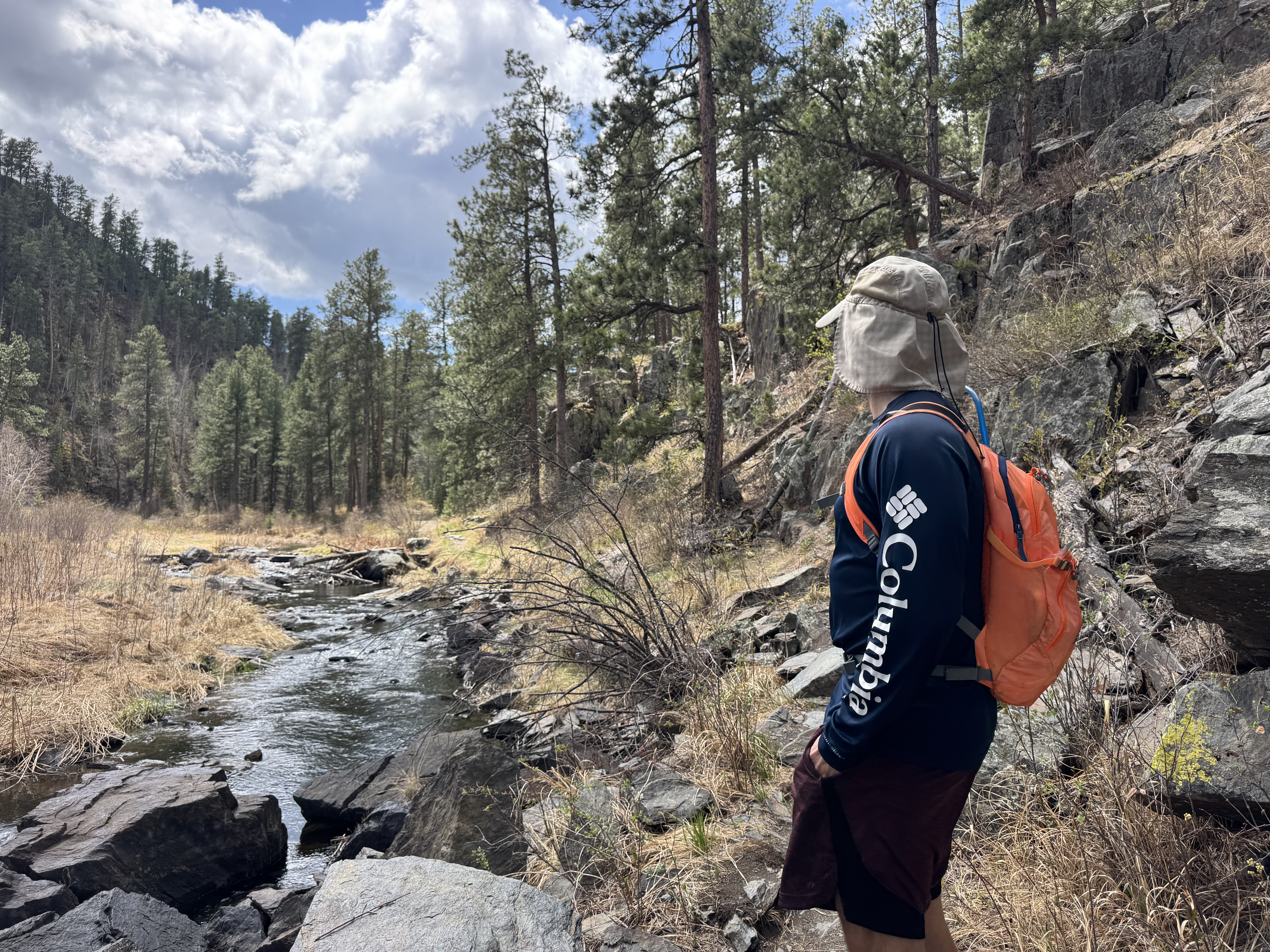
Spring in the Black Hills is one of my favorite times of year to be outside. The snow has finally cleared from the lower trails, the creeks are running fast with snowmelt, and the forest is starting to come back to life. Last weekend I had a chance to get out and hike the Spring Creek and Flume Trail Loop — a beautiful route just outside Rapid City — and it was a good reminder of how much there is to enjoy here as the season turns.
Spring Creek and the Flume Trail Loop
The trail follows Spring Creek through a narrow canyon, with tall granite walls on one side and pine forest on the other. In several places the path crosses the creek on small bridges or stepping stones, and there are quiet pools where the water slows and reflects the trees overhead. It's the kind of landscape that doesn't really photograph well — it has to be walked.
The Flume Trail portion of the loop follows the route of an old water flume built in the 1880s during the gold rush era. The original wooden flume is long gone, but the path it carved into the hillside remains, and at one point the trail passes through a hand-cut tunnel blasted through solid rock. Walking through it is a strange little reminder that this landscape has a long human history layered on top of the natural one.

Why Spring Is a Great Time to Be Out
Hiking in May has a few advantages over the peak summer months. The temperatures are comfortable, the bugs are not yet in force, and the trails are far less crowded than they will be in July. If you live in the Black Hills, or are passing through, this is a great window for getting outside before the summer crowds arrive.
That said, more time outside means more skin exposed to the sun and to the plants around us. Sun protection is a favorite topic, but there's another spring and summer trail hazard worth being aware of — and one I see regularly in clinic this time of year.
A Word on Poison Ivy: Rhus Dermatitis
Rhus dermatitis is the medical term for the allergic contact dermatitis (rash) caused by poison ivy, poison oak, and poison sumac — plants in the Toxicodendron family. The culprit is an oily resin called urushiol, found in the leaves, stems, and roots of the plant. It's one of the most common forms of allergic contact dermatitis worldwide, and the great majority of adults will react to it if exposed.
The rash typically shows up 12 to 72 hours after contact, often in streaky or linear patterns that match where a leaf or stem brushed the skin. It's intensely itchy, often blistering, and can last weeks. One thing patients are often surprised by: the fluid in the blisters does not spread the rash, and the rash itself is not contagious. What does spread it is residual urushiol — on clothing, hiking poles, shoelaces, or pet fur — which can cause a new reaction days later if it isn't washed off.
How to Avoid It on the Trail
In the Black Hills, poison ivy tends to grow in the understory along creek beds, in disturbed sunny patches along trail edges, and in lower elevations of the forest — precisely the kind of habitat you walk through on a creek loop. It usually grows as a low ground cover here rather than the climbing vine seen further east, and the classic identifier still applies: leaves of three, let it be. The leaflets are often glossy, sometimes with a reddish tint in spring, and the plant changes color dramatically into the fall.
Long pants, socks above the ankle, and staying on the main trail are the simplest defenses. If you're hiking with a dog, keep in mind that urushiol clings to fur, and you can react to whatever your pet brushed against.
If You Get Exposed
If you think you've contacted poison ivy, the most useful thing you can do is wash the area thoroughly with soap and water as soon as possible — ideally within 30 minutes, but even later washing helps remove residual oil. Wash any clothing, shoes, gear, and pets that may have come into contact as well. For a mild rash, cool compresses, over-the-counter hydrocortisone, and oral antihistamines can help with the itch. For a widespread rash, one involving the face or genitals, or one that simply isn't improving, it's worth seeing a dermatologist.
Spring in the Black Hills is a great reason to get outside, and the Spring Creek and Flume Trail Loop is one of the better ways to spend a Saturday morning here. A little awareness of what's growing trailside — and a quick rinse afterward — goes a long way toward keeping the experience a great one!
Reference: DermNet. Plant dermatitis. Accessed May 2026.