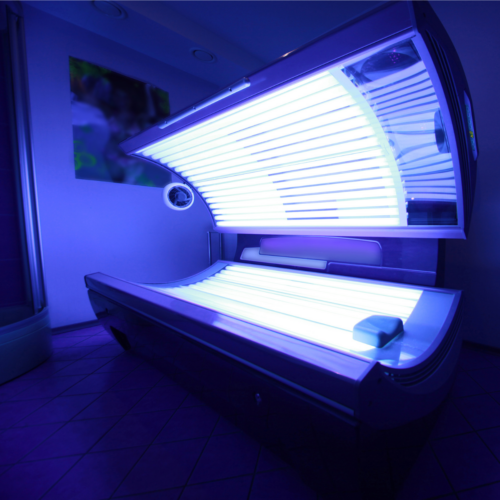
Tanmaxxing: it describes tracking the UV index through the day, identifying the window when it peaks, and going outside specifically then. Some tanmaxxers also use tanning beds. The word borrows from "looksmaxxing," the broader internet project of optimizing your appearance, and it treats a tan as something you train for rather than something you happen to get.
Tanmaxxers are responding to a genuinely persuasive stream of content, and some of what they believe has a kernel of truth. But the underlying trade is a bad one.
Survey Shows…
The American Academy of Dermatology surveyed 1,132 US adults in early 2026. Among Gen Z respondents, 64% had encountered sunscreen misinformation online, compared with roughly half of Americans overall. Thirty-six percent named Instagram or TikTok influencers as their primary source of skincare advice, versus 21% of Americans overall. A third of Gen Z respondents scored a D or F on the AAD's sun-safety quiz, and they were overconfident in their own knowledge.
An earlier AAD survey found that 28% of Gen Z said getting a tan was more important to them than preventing skin cancer. A separate Orlando Health survey found that about one in seven adults under 35 believed daily sunscreen use is more harmful than direct sun exposure.
That last number is the one I find most telling. It is not indifference to health. It is a sincere belief that the protective measure is the dangerous one.
What Actually Happens in the Skin
Some recent data on indoor tanning comes from a Northwestern study published in Science Advances in December 2025, and it is worth understanding. The study compared about 3,000 tanning bed users with 3,000 age-matched controls. Melanoma was recorded in 5.1% of the tanning bed users and 2.1% of the controls, and the gap held up after accounting for age, sex, family history, and sunburn history.
The researchers also sequenced DNA from 182 individual melanocytes taken from indoor tanners, non-tanners, and cadaver donors. Melanocytes from the tanning bed users carried nearly twice as many mutations.
A tanning bed delivers a uniform dose to areas we do not usually think of as sun-damaged. Dr. Pedram Gerami (a graduate of the University of Iowa Dermatology program) noted that they found precursor mutations in normal-appearing skin containing no moles at all. His read is that a tanning bed exposes a much wider field of skin to mutagenic UV than outdoor sun does, since outdoor exposure concentrates where the sun actually lands.
The AAD's numbers line up. Indoor tanning raises squamous cell carcinoma risk by 58% and basal cell carcinoma by 24%, and starting before age 20 raises melanoma risk by 47%. A 2012 meta-analysis of 27 studies found a 59% increase for anyone whose first use came before age 35. Indoor tanning can more than double melanoma risk.
And on the most common defense — "I don't burn, I just tan" — the evidence does not support it. People who tan indoors without burning still carry increased melanoma risk. A tan is the visible record of DNA damage that already happened.
The Lag Between Exposure and Disease
Melanoma can develop years to decades after the UV exposure that contributed to it. In one Minnesota study of indoor tanners, the interval between when women started tanning and when they were diagnosed ran from roughly 10 to 21 years depending on the age group.
That lag is why current cancer statistics cannot settle this. Whatever tanmaxxing eventually does to melanoma rates, the data that would show it does not exist yet. That absence is not reassurance.
The Safe Tan
Self-tanning lotions and creams are genuinely fine. The active ingredient in nearly all of them is dihydroxyacetone, which reacts with dead cells in the outermost layer of skin to produce color. You get the color without UV exposure or the UV-induced damage that comes with sunbathing and tanning beds. If you want to be tan, this is the way to do it.
Two caveats. The FDA clears dihydroxyacetone for external application only and advises against inhaling it or getting it in your eyes and lips, which matters in a spray booth more than with a lotion — ask about eye and nose protection. And a sunless tan provides essentially no sun protection. It looks like a tan without functioning as one, so sun-protection rules still apply.
Just Say No to Melanotan
The exception to "cosmetic tanning is fine" is melanotan, sold online and through some gyms and salons as the "Barbie drug" or "tan jabs." Melanotan I and II are synthetic analogues of α-melanocyte-stimulating hormone, taken by injection or nasal spray.
The regulatory picture is worth getting right, because sellers exploit the confusion. Melanotan II is unapproved everywhere. Melanotan I is the same molecule as afamelanotide, which the FDA approved in 2019 as an implant called Scenesse to increase pain-free light exposure in adults with erythropoietic protoporphyria. That approval covers one manufactured product for one rare condition. It does not extend to powder bought online, and sellers who invoke it are cashing in on a technicality.
These compounds do produce a tan. They also produce problems. Australian regulators tested five seized nasal spray bottles and found estimated melanotan II content ranging from 22 mg to 54 mg per bottle across products sold as the same thing, which means users have no real idea what dose they are taking. Users develop darkening and enlargement of existing moles along with eruption of new atypical-appearing ones, which makes melanoma surveillance considerably harder. Reported systemic effects include rhabdomyolysis and renal dysfunction requiring intensive care. Case reports describe melanoma arising during or after use, including an oral mucosal melanoma following nasal spray — single cases that raise concern without establishing cause.
The Trade-off
A tan is a temporary aesthetic effect. The mutations underneath it are not temporary. If the look matters to you, there is a version you can have without the trade. It comes in a bottle, and it washes off.
Disclaimer: This article is general educational content, not medical advice. If you have a mole or skin lesion you are concerned about, see a board-certified dermatologist for evaluation.
References
American Academy of Dermatology. Skin cancer: indoor tanning statistics and facts.
American Academy of Dermatology. Misinformation puts over 16 million Americans at an increased risk for skin cancer. Survey of 1,132 US adults, fielded January 19–February 2, 2026. Released May 1, 2026.
Orlando Health Cancer Institute. Survey finds young adults more likely to believe myths about sun protection and skin cancer prevention. Ipsos survey of 1,021 US adults, March 2024.
Gerami P, et al. Molecular effects of indoor tanning. Science Advances. December 2025.
Boniol M, Autier P, Boyle P, Gandini S. Cutaneous melanoma attributable to sunbed use: systematic review and meta-analysis. BMJ. 2012;345:e4757 (see published correction).
Lazovich D, Isaksson Vogel R, Weinstock MA, Nelson HH, Ahmed RL, Berwick M. Association between indoor tanning and melanoma in younger men and women. JAMA Dermatology. 2016;152(3):268–275.
US Food and Drug Administration. Sunless tanners and bronzers: dihydroxyacetone guidance.
US Food and Drug Administration. FDA approves first treatment to increase pain-free light exposure in patients with a rare disorder (afamelanotide / Scenesse). October 2019.
Therapeutic Goods Administration (Australia). Melanotan II tanning peptide products found to be inconsistently dosed. August 2026.
Nelson ME, Bryant SM, Aks SE. Melanotan II injection resulting in systemic toxicity and rhabdomyolysis. Clinical Toxicology. 2012.
Alsabbagh AY, Bhujel N, Singh RP. Melanotan II nasal spray: a possible risk factor for oral mucosal malignant melanoma? International Journal of Oral and Maxillofacial Surgery. 2025.
Dermatology Times. Why Gen Z is choosing tanning over skin protection.