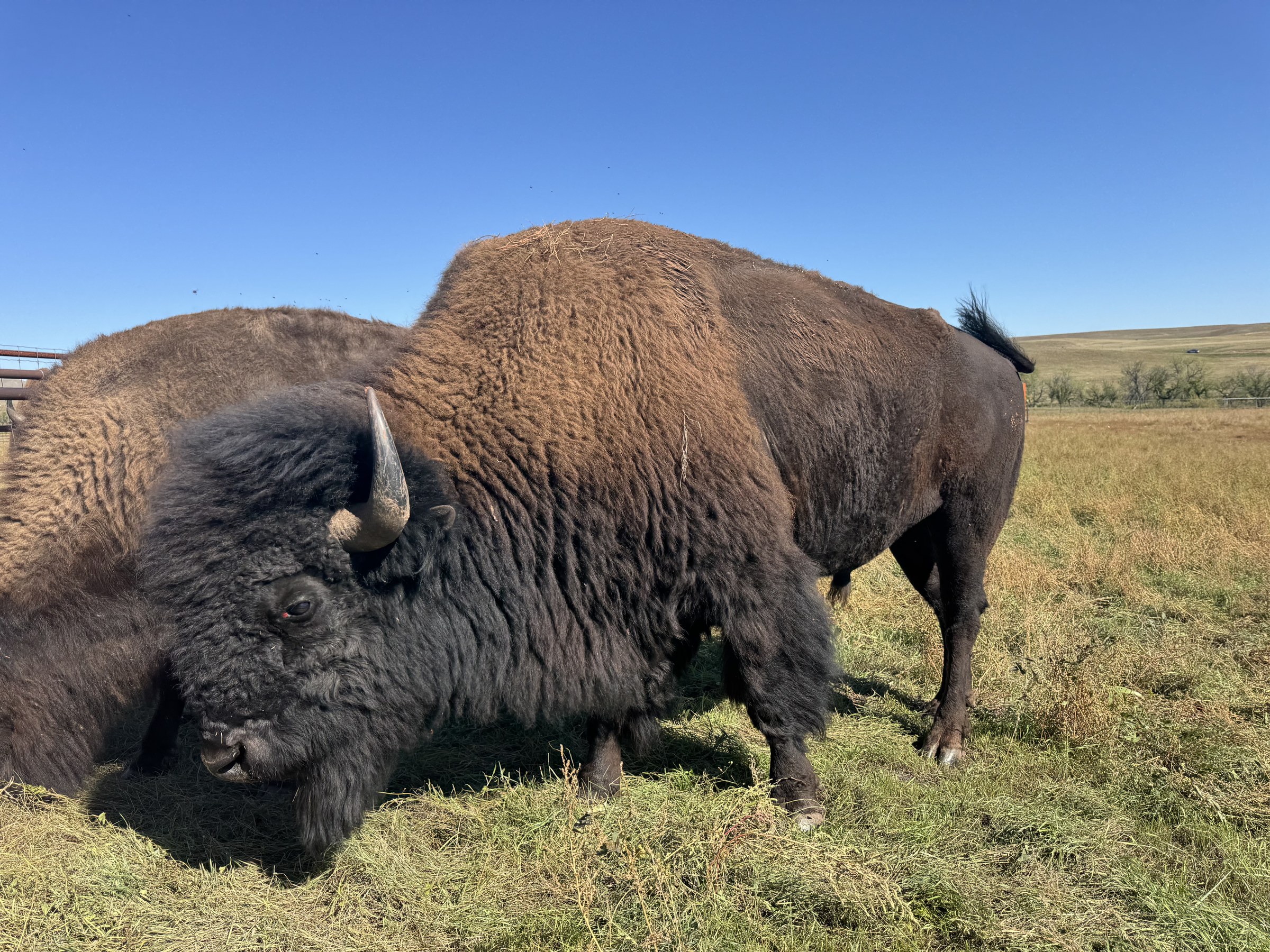
The 61st annual Buffalo Roundup at Custer State Park took place a few weeks ago with more than 20,000 people coming out. Every September, riders on horseback drive the park’s herd across the hills and into the corrals. There the animals are checked, vaccinated, and part of the herd is sorted for sale at auction.
The Herd
The herd began in 1914, when South Dakota bought 36 bison from the estate of James “Scotty” Philip. Today it numbers roughly 1,300 to 1,500 animals that are spread across the 71,000 acres of Custer State Park.
The park’s newest building is the Bison Center, which opened in 2022 near the corrals. It exists largely because of one visitor: Walter Panzirer. He was painting the corral fences as part of his son’s Boy Scout project. He noticed a steady stream of cars and buses stopping at the corrals, but nothing there explained the Roundup. As a trustee of the Helmsley Charitable Trust, he directed funding for the Bison Center, whose exhibits cover the herd’s history, how it is managed, and the Roundup itself.
The Bison
The animal at the center of all this is not technically a buffalo. The American bison belongs to the same family as the African Cape buffalo and the Asian water buffalo, but only distantly. True buffalo lack the bison’s massive shoulder hump, shaggy head, and beard. The name likely stuck because early European settlers reached for a word they already knew, possibly from the French “boeuf.” In 2016 the bison became the national mammal of the United States.
That hump is worth investigating. It is not fat but rather muscle that is anchored to unusually long spines on the vertebrae over the shoulders. It powers the side-to-side sweep a bison uses to clear snow off the grass in winter.
The Other Buffalo Hump
In medicine, “buffalo hump” means something else: a pad of fat that builds up at the base of the neck, between the shoulder blades. It is one of the classic signs of Cushing syndrome, a state of steroid excess. The most common cause is not an intrinsic disease but iatrogenic, from long-term use of steroids like prednisone.
Prednisone’s Cutaneous Effects
The skin harbors many signs of chronic prednisone use:
- Thin, fragile skin that tears easily
- Easy bruising
- Stretch marks (striae) that tend to be wide and red-purple
- Small visible blood vessels (telangiectasias)
- Steroid acne
- Impaired wound healing
- Excess hair growth
- More frequent skin infections, especially fungal
Prednisone’s Origin Story
In September 1948, Philip Hench at Mayo gave a new adrenal hormone, then called compound E and later named cortisone, to a woman with severe rheumatoid arthritis. Her improvement was dramatic, and Hench shared the 1950 Nobel Prize with Edward Kendall and Tadeus Reichstein for the work.
The problem was supply. Early cortisone was made in roughly three dozen chemical steps starting from ox bile, which meant it was both scarce and expensive. Percy Julian, a chemist at the Glidden Company in Chicago, developed an industrial method for making a cortisone precursor from soybean oil. This was a key advance to boost supply and decrease cost.
Around 1950, Arthur Nobile at Schering found that bacteria could convert cortisone into a more potent compound that we know today as prednisone. It was approved by the FDA in 1955, and rheumatoid arthritis was among its first uses.
The Dermatologist’s Armamentarium
Dermatology was a big winner from the invention of prednisone. Pemphigus vulgaris is a severe skin disease in which the immune system attacks the connections holding skin cells together, resulting in skin and mucosal sloughing. Before steroids, it was fatal in roughly three out of four patients. Early steroid treatment brought mortality closer to 30%. Modern treatment of pemphigus has reduced the mortality even further but prednisone remains a hallmark of the treatment regimen.
Seventy years later, prednisone is still a key weapon in the dermatologist’s armamentarium. It is used to treat problems from the more banal, like allergic reactions to poison ivy, to the exotic, such as autoimmune blistering diseases. While an actual bison’s hump serves a purpose, the prednisone-induced buffalo hump serves none. This, along with many other side effects, is why dermatologists limit courses of prednisone to as short as possible.
Disclaimer: This article is general educational content, not medical advice. Questions about a medication or a skin concern are best directed to your own physician or a board-certified dermatologist.
References
South Dakota Game, Fish and Parks. Buffalo Roundup and Arts Festival. Link
South Dakota Game, Fish and Parks. Custer State Park history. Link
South Dakota Game, Fish and Parks. Custer State Park Bison Center. Link
South Dakota Public Broadcasting. Connection with billionaire’s heir drives Custer State Park project. February 18, 2021. Link
Smithsonian’s National Zoo. It’s bison, not buffalo, and other American bison facts. Link
Mayo Clinic Libraries. Discovery of cortisone. Link
Harvard Department of Chemistry and Chemical Biology. CCB spotlight: Percy Lavon Julian. Link
National Inventors Hall of Fame. Arthur Nobile. Link
Federal Register. Determination that METICORTEN (prednisone) tablets were not withdrawn from sale for reasons of safety or effectiveness (NDA 09-766, approved February 21, 1955). December 1, 2017.
Side effects of chronic systemic glucocorticoid therapy: what dermatologists should know. An Bras Dermatol. Link
Skin manifestations of Cushing’s syndrome. Link
Lever WF. Pemphigus. Medicine (Baltimore). 1953;32(1):1–123.