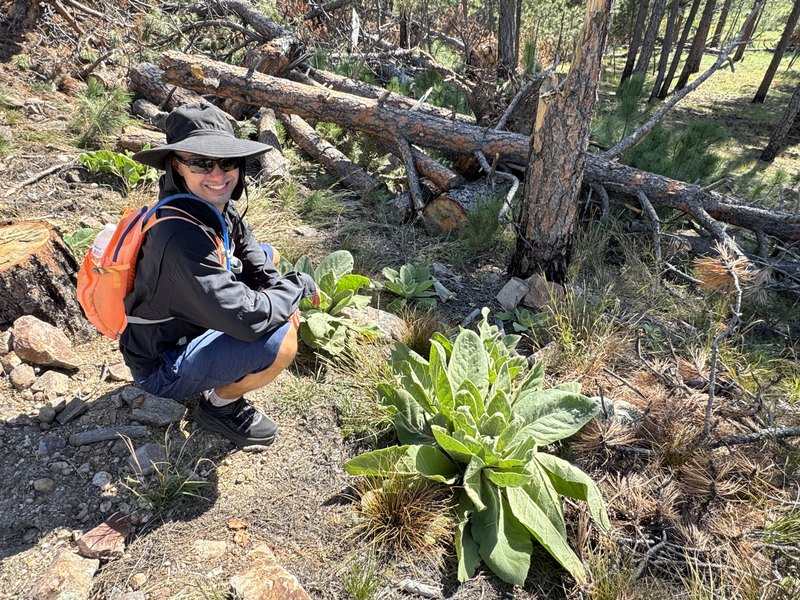
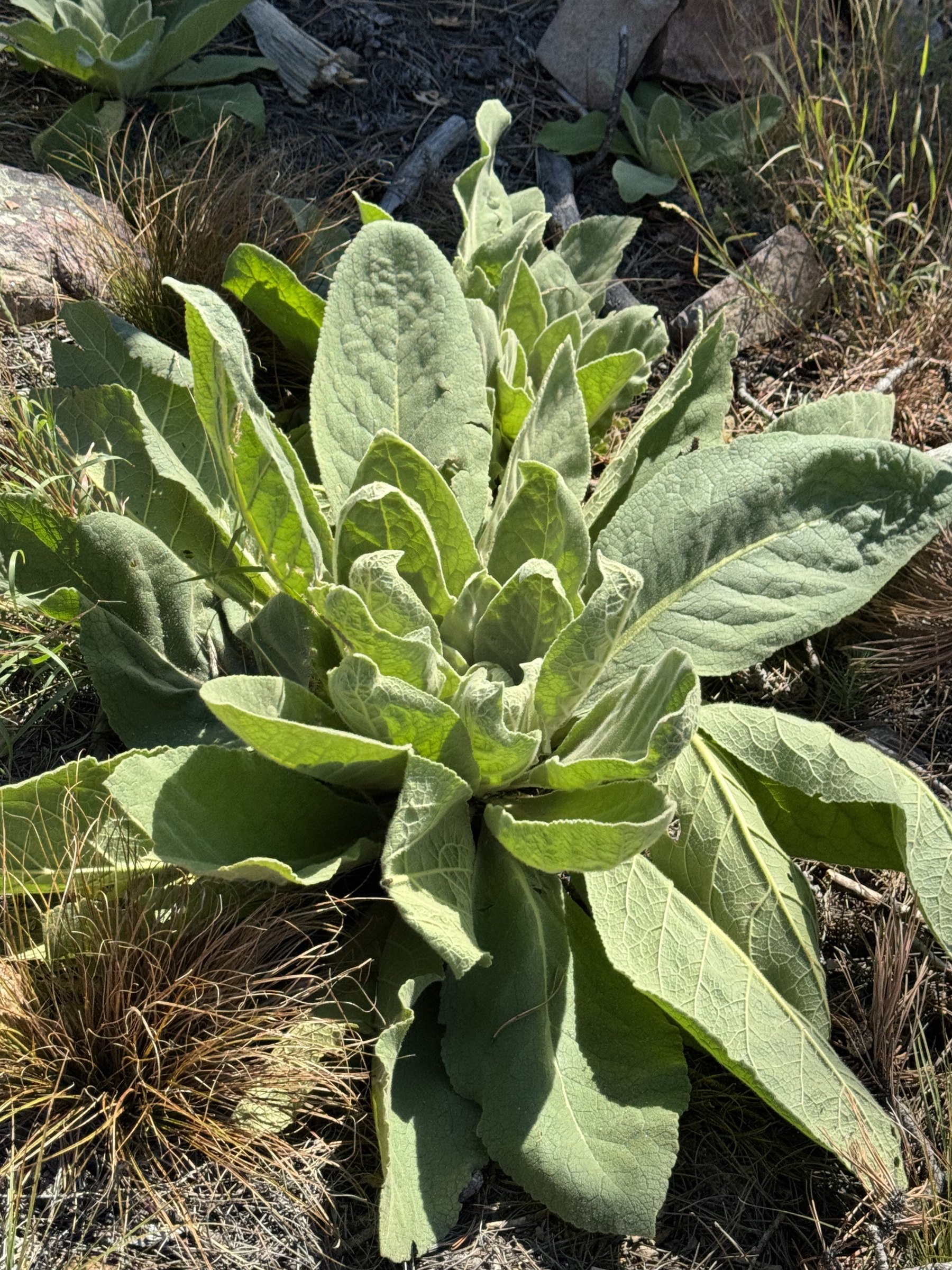
While hiking Lover’s Leap in Custer State Park in late summer, I spotted it: a big rosette of silvery-green leaves that looked like soft velvet. While it may be silky smooth in its first summer, by year two it shoots up a single flower stalk that can top 6 feet, studded with small yellow flowers that are reminiscent of a Dr. Seuss sketch. The dichotomous plant is great mullein (Verbascum thapsus), and in Western SoDak, it has a much more colorful name, which is a hat tip to its history: cowboy toilet paper.
A Frontier Bathroom Solution
Imagine yourself on a long cattle drive in the 1870s, miles from the nearest general store, and nature suddenly calls. Frantically searching about, you spot numerous plants with large leaves as soft as felt. Pleased with your good luck, you snag a few leaves just for the occasion...
How often cowboys actually used great mullein for bathroom tissue is more lore than recorded history. However, the nickname has stuck all the same, and occasionally outdoor survival guides list mullein as an emergency stand-in for toilet paper.
Great mullein wasn’t originally an American plant. It’s native to Europe, northern Africa, and Asia. European settlers brought it to North America during the colonial period, where it was grown as a medicinal herb and also used as a fish poison: compounds in the plant, especially the seeds, can stun fish. As settlement moved west, mullein spread with it, eventually becoming the familiar roadside weed seen across much of the West today, including the Black Hills.
The Protean Plant
Cowboys weren’t the only ones to find a creative use (or name) for mullein.
- Torches and wicks: Ancient and medieval accounts describe dried mullein stalks coated in fat or tallow and burned as torches. This earned it the moniker “hag’s taper.” The plant’s fibers were also reportedly used as lamp wicks, which likely gave rise to the “candlewick plant.”
- Quaker’s rouge: According to folklore, Quaker women rubbed the leaves on their cheeks for a rosy glow.
The Quaker trick is the tell. A plant that turns your cheeks pink when you rub it on them is irritating your skin. Now think about where cowboys were reputedly rubbing it…
The Fuzzy Problem
Under a microscope, mullein’s velvety coating turns out to be a dense forest of tiny branched, star-shaped hairs called trichomes. They help the plant hold onto water and discourage grazing animals, which partly explains why livestock tend to leave mature mullein alone.
On human skin, those tiny hairs can break loose and mechanically irritate the skin. The resulting reaction is best thought of as irritant contact dermatitis rather than a true allergic process. Microscopic plant hairs rubbing against the skin can produce itching, burning, and redness, similar in principle to the irritation fiberglass causes. Now imagine that irritation on some very sensitive real estate compounded with a long ride in the saddle; clearly not every cowboy story had a happy ending.
What to Do If You’ve Been Mulleined
Fortunately, most cases are mild and self-resolve, but here are some tips to soldier through.
- Rinse, don’t scrub. Gently wash the skin with lukewarm water and mild soap to remove as many loose hairs as possible. Scrubbing only adds friction.
- Don’t touch. If the area still feels irritated after washing, stop rubbing and minimize friction.
- Calm the inflammation. Over-the-counter 1% hydrocortisone cream, used for a few days, can calm redness and itching. Topical corticosteroids work by turning down the skin’s inflammatory response.
- Protect the skin. A plain barrier ointment like petroleum jelly or zinc oxide reduces friction while the skin recovers.
A Few Fun Facts
- One plant can produce 100,000-200,000 seeds.
- The seeds can stay viable in the soil for decades. A close relative, moth mullein, sprouted after more than a century in a famous buried-seed experiment in Michigan.
- Mullein loves disturbed ground: roadsides, overgrazed pastures, and especially burn scars.
- It’s usually a biennial. It spends year one as a fuzzy rosette and year two as a towering flower spike. It subsequently dies, leaving its dried stalk standing like a sentry through the winter.
The Bottom Line
Mullein is part of the Black Hills landscape and part of its frontier lore. Admire it, photograph it, tell your friends the cowboy story. But I recommend against testing the legend yourself. Before venturing out on your next long hike, plan ahead to pack your own TP in or pay the price if you wipe.
Disclaimer: This article is general educational content, not medical advice. For a rash that is severe, spreading, or not improving, see your own physician or a board-certified dermatologist.
References
Bugwood Wiki. Verbascum thapsus. Link
Global Invasive Species Database. Verbascum thapsus. Link
Montana State University Extension. Common mullein. Link
Telewski FW, Zeevaart JAD. The 120-yr period for Dr. Beal’s seed viability experiment. Am J Bot. 2002;89(8):1285–1288.